Thursday, June 10, 2010

The Consequences of Earshot

I've always been a merciless eavesdropper but much as Alaphia points out here about its merits, it has its own consequences... on one's sanity!

We have a Flexidesk system at work - Flexidesk is companyspeak for
"Let's see if you can reach early enough to catch a chair, the number of which outnumber by 2:1, the building's occupants". A.K.A. "Gotcha".

What this hustle means is that one's neighbour varies everyday, an absurdist human lottery of sorts... the glorious gongura-pickle eating South Indian, the Frenchman going
brrrppoooofff all the time, the Arab who seems to hiss at/curse everyone's grandfathers, the stinky nerd with the shiny Mac, the woman with hula-hoops on her ears impeccably complemented by a Chanel No.5 forcefield and the occassional tobbaco chewing Texan. All stereotypes duly make their appearance at regular intervals.

Today, however, is an outlier of a day. There is a plain looking 55+ year old man next to me. Harmless almost, until he gets on the phone. Wears a tie, really looks white but speaks Sinhalese to his relatives. He varies his accent depending on whom he speaks to and presents his complicated surname to Brit callers in two simple syllables. He calls his niece on the office phone to tell her friend about not mentioning his Tamil origin on his UK visa application.

Needlessly funny at most times, he tells a caller to hold on for a second while he weeps in the corner and comes back. To another, he shares the discovery of his professional incompetence by the company (in a hushed tone) and shares his new responsibilities which may include shredding blank paper and fetching vanilla tea. He has been apparently reassigned as part of a management shakeup (he shakes himself, his chair and MY desk, somehow communicating the agony of it all, down the thin copper line) and is awaiting his new role.

He explains to his cousin how senior managers in the firm are practititioners of the exotic language of
Jar-Gon-Ese and also how his new boss was supposed to turn up to tell him what to do but has been AWOL for the last 5 days and so he enjoys the sun in the office atrium but has regretfully left his suntan lotion at home.

Then he calls to check on his aunt in a care-home. On being told that she is asleep, he signs off thus "Tell her that her
little nephew, 'S' called and that he is praying for her daily".

The wonder, the horror. Yet another day winds down.

Image sourced from here.

Tuesday, June 08, 2010

And I too suffer...

"...but always pity brought me back to earth. Echoes of cries of pain reverberate in my heart. Children in famine, victims tortured by oppressors, helpless old people a hated burden to their sons, and the whole world of loneliness, poverty, and pain make a mockery of what human life should be. I long to alleviate the evil, but I cannot, and I too suffer..." Bertrand Russell in The Prologue to his autobiography.


I just finished Susan Sontag’s “Regarding The Pain of Others” and it was a such a strong reminder of all the reasons why I love reading and how a powerful compendium of words can ram home unpalatable truths. In this book, Sontag makes an unflinching study of the many images of human distress and dissects our thinking as we consider such images. In doing so, she not only spells out the tenuous limits of morality (during wartime, especially) but also marks the larger manipulation of memory that human society chooses to live with.


Some excerpts from the book:

"...and the pity and the disgust that pictures like Hick's inspire should not distract you from asking what pictures, whose cruelties, whose deaths are not being shown"


“When Woolf notes that one of the photographs she has been sent shows a corpse of a man or woman so mangled that it could as well be that of a dead pig, her point is that the scale of war's murderousness destroys what identifies people as individuals, even as human beings”


“It is the same intelligence whose weapons of annihilation can locate the enemy to the exact second and meter, wrote Junger, that labors to preserve the great historical event in fine detail.”


“The exhibition in photographs of cruelties inflicted on those with darker complexions in exotic countries continues, oblivious to the considerations that deter such displays of our own victims of violence; for the other, even when not an enemy, is regarded only as someone to be seen, not someone (like us) who also sees; but surely the Taliban soldier begging for his life whose fate was pictured prominently in the NY Times also had a wife, children, parents, sisters and brothers, some of whom may one day come across the three colour photographs of their husband, father, son, brother being slaughtered-if they have not already seen them.”


“Photographs that everyone recognizes, are now a constituent part of what a society chooses to think about or declares that it has chosen to think about...what is called collective memory is not a remembering but a stipulating; that this is important and this is the story about what happened with the pictures that lock the story in our minds.”


“The problem is not that people remember through photographs but that they remember only the photographs… to remember is, more and more, not to recall a story but to be able to call up a picture.”


“Someone who is perennially surprised that depravity exists, who continues to feel disillusioned (even incredulous) when confronted with what humans are capable of inflicting in the way of what humans are capable of inflicting in the way of gruesome, hands-on cruelties upon other humans, has not reached moral or psychological adulthood.”


“Whom do we wish to blame? More precisely, whom do we believe that we have the right to blame? The children of Hiroshima or Nagasaki were no less innocent than the young African American men (and women) who were butchered and hanged from trees in small-town America… A stepped-up recognition of the monstrousness of the slave system that once existed, unquestioned by most in the United States is a national project that many Euro-Americans feel some tug of obligation to join. This ongoing project is a great achievement, a benchmark of civic value. The acknowledgement of the American use of disproportionate firepower in war (in a violation of one of the cardinal principles of war) is very much not a national project… would be regarded-now more than ever-as a most unpatriotic endeavor.”


“We don’t get it. We truly can’t imagine what it was like. We can’t imagine how dreadful, how terrifying war is; and how normal it becomes. Can’t understand, can’t imagine. That’s what every soldier, and every journalist and aid worker and independent observer who has put in time under fire and had the luck to elude the death that struck down others nearby, stubbornly feels. And they are right.”


The book is available at Amazon for $9.36. Capa's falling soldier picture from the BBC site here.

Characters on The Underground


The man with the glass-ball – 16th January 2010 (Piccadilly)

A wild haired man with blonde hair curly and pointing in all directions. Large eyes, small jowls on his cheek, tiny chin. Stands next to door leaning on glass partition. Takes off coat. Rolls up sweater sleeves. Takes out a glass ball about the size of a small football. Holds it on palm then turns palm upside down and holds ball on top. Then glides it to crook of elbow. Up and down. Left to right. When Holborn hits, takes it on left side and makes a block gesture with his right. I pretend to look the other way and get off at Notting Hill Gate.


The girl without makeup – 19th January 2010 (Central)
Indian origin; camel haired coat, stockinged feet, Padukone lookalike, more rounded. No rings. Unusually large calves, firm and stockinged. No makeup. Plain well tended nails. No lipstick, no mascara, no rouge, no nail polish, no eyeliner. Maybe coming in from the gym? Rolls eyes to side and I see them... black. Black flat shoes with small silver bows. The crowd pushes us nearer but I edge away from the brush of her hair. It is, after all, a disturbing feeling. Gets off at Chancery Lane.


The kid with the touch-screen phone – 10th April 2010 (Central)

Little blonde kid, lavender crocs, tights with metal studs around the ankle, plastic hair-band. Black short-sleeved tee that reveals gangly, long arms. About 8 years old. Fiddling with a Palm Pre encased in florescent green rubber. Looks up at Mom who's busy reading a magazine. Turns away and licks touch-screen with tongue to see if it works. Tiny delighted smile when it does. Briefly struggles with thought of sharing discovery with Mom. Decides to. Mom nods, smiles and turns away. I nod to the little discoverer in acknowledgement. 1845 hours on the Central line.


Image from this Evening Standard article with Tube Trivia

Saturday, May 15, 2010

Admiring the King's legs, among other things...

In 3 hours at The National Portrait Gallery, you can discover:
  1. In a corner, next to the portrait of Lady Jane Grey, queen of England for a week, a girl’s reply to a museum notice board that asked visitors to list down what they would do if they were The Queen for a day: “Joe Jonas would be my king; I would wear only the crown jewels and walk around the palace”. Go Joe!
  2. That Queen Henrietta Maria thought that the future King Charles II at the tender age of 4 months was “so fat and so tall that he is taken to be a 1 year old”.
  3. Some of the girls who strew flowers as Princess Alexandra landed at Gravesend were maybe prettier than the princess herself.

History being airbrushed at 'The Indian Portrait, 1560-1860' exhibition...
  • Ghulam Ali’s portrait of Bahadur Shah II, a cultivated poet and calligrapher who was “sent into exile into Rangoon”... Hah! Put in a cage like a monkey, stripped of all human privileges and made to live & die in filth – tragically recounted in Dalrymple’s brilliant book, “The Last Mughal”
  • One man’s betrayal can be another man’s 'brought over' – Francis Hayman’s painting of Rob Clive receiving the homage of Mir Jaffir after the Battle of Plassey describes how Mir Jafffir ‘brought over’ his troops to Clive and was appointed Nawab of Bengal for his support. A lowly traitor in Indian history becomes a “well rewarded supporter” at the National Portrait Gallery. Amen.
  • Quiet sense of wonder at how Mughal art, architecture and literature did their Persian roots proud.

Moving on, you will encounter...
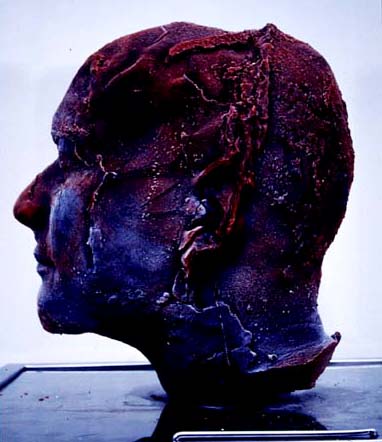
  • The red red bust of the artist, Mark Quinn (“Self”) cast and frozen in several pints of the artist’s own blood, maintained by a refrigerating unit, reminding us “of the fragility of existence”.
  • That Mary, Queen of Scots was the first woman to play golf and the word “caddy” evolved from the French military “cadets” who carried her clubs in France.
  • The smooth, lovely, long legs... of the King of England!
  • The gently entwined hands of the eloped poet-couple, Robert Browning and Elizabeth Barrett Browning, captured in bronze for eternity by Harriet Hosmer
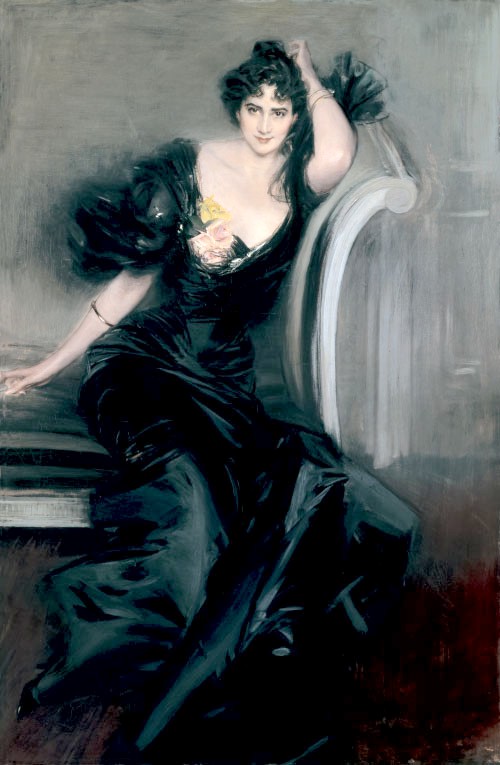
  • The impeccably stylish Lady Colin Campbell, painted in black(dress) & ivory(skin) by Boldini; a stunning woman of “lightning wit” who married His Lordship, not knowing he was suffering from syphilis. It must be noted that she sometimes "wore a live snake around her throat in hot weather because it keeps one's neck so cool".
  • The Raging Red Eyes from the “Head of A Man” by L.S.Lowry who poured out his impotent rage as he watched his mother’s life ebb away... few know that he moon-lighted as a rent-collector. The many lives of angry artists.
  • The plaster bust of Dorothy Russell sculpted by the psychoanalyst, psychiatrist and artist, Ismond Rosen... a deserving honor, no doubt for the first woman to hold the 'Chair of Morbid Anatomy' at the London Hospital Medical College, apparently an eminent position, which a few of us might find semantically interesting.
  • The ascetic profile of DH Lawrence, infused with all the suffering brought about by the obscenity trial of 'Lady Chatterly’s Lover'. If you peek around with sufficient enthu, you might even spot the ironic Philip Larkin and his ‘Annus Mirabilis’, celebrating the discovery of sexual intercourse in 1963 when the book was finally allowed to be published (the first edition of which was dedicated to the jurors who returned the verdict of ‘Not Guilty’ in the obscenity case)
  • Paul McCartney, blissfully bleeding colour all over as “Mike's Brother” by Sam Walsh
  • Dame Judi Dench, looking like The Angel of Soothing Death, her mop of hair well-coordinated with her dress and matching the immaculate white of the canvas.
  • And if you’re persistent enough and try to escape to the basement as the closing bell rings, you will discover “The Singh Twins” series, a delightful modern interpretation of miniature Indian Art by Amrit & Rabindra, twin BBCD sisters. This colourful collection is complete with texting phones and DDLJ in the background... and even Muhammed Ali, reminding us (and all Americans) about his personal stand against the Vietnam War - “after all, no Vietnamese ever called me a nigger”. Truly, The Greatest Hath Spoken.
  • Until I saw their 1984, I did not know that at least 484 civilians were slaughtered in Operation Blue Star; always remembered it from high school history as a terrorist vs. army story. Another case of History being kind to those who write it, no doubt.

And in the final minutes as one slips down to the toilet, Venetia Dearden interrupts us with her work on the Glastonbury Festival... the strikingly innocent face of a young girl splendidly contrasting her pierced nipples and navel, around which her equally metaled boyfriend’s arms wrap around.

A cold, rainy afternoon, well spent, topped off with Kir Royale and some sautéed garlic mushrooms. Ooh-la-lah.

Tuesday, May 11, 2010

A Day In The Life Of India

The official global narrative of events in India is sometimes so misleading, that when the truth emerges, foreigners are stumped at the impossible contradiction of how we are the way we are. Here are two examples:

Case No 1: TELECOM-GATE

Official story: Government privatizes telecom, market booms, consumers get cheap handsets and cheaper tariffs, behold the world's fastest growing telecom market.
Unofficial story: In the background, someone in the Telecom Ministry auctions spectrum without proper guidelines or government consensus for what must have been “super-sized-incentives”. Real estate firms, stock broking firms, Tom, Dick, Chotu and Hari all apply for spectrum (after all, there’s no ‘tender’, it’s on a first-come, first served basis) and a small number of firms without any telecom expertise get valuable spectrum at grossly under-priced 2001 rates. The buyers (make that brokers) quickly mark up and resell licenses to foreign operators for huge profits soon after. Issue becomes public thanks to media (Ave 'The Pioneer'!) doing its glorious duty of exposing all, opposition parties demand resignation. The leader of the coalition party (to which the minister belongs, goes to Delhi, trots out the much-flogged, completely irrelevant caste horse. Matter not being actively pursued by Government because of the delicate nature of the coalition government. Oooooh.
Cry, My Beloved Country.

Case No: 2: IPL GATE
Official story: America-returned entrepreneur back in India, replicates NBA-style model for cricket, rejuvenates the sport, film stars cheer their own teams, nation rejoices & gets glued to new format.
Unofficial story: A junior minister jumps in to "mentor" a league bid, impropriety suggested, he resigns, other murky deals by murkier politicians come to light, the aviation minister’s daughter cancels a scheduled flight of the state owned airline and uses the plane to charter self and cricketers from her team. Caught in scandal, aforementioned entrepreneur claims innocence, denies owning proxy stakes in different teams, releases occasional emotional tweet, expresses sense of wonder and amazement about personal astrological predictions (including but not constrained to: ...is a dynamo...a package of raw radioactive energy... a true Pluto child... will soar like a phoenix... will conquer the 25 moons of Jupiter, surf the rings of Saturn and tenderly twist the time-space continuum... ok, I made up the last one), on verge of getting sacked, prepares to defend himself, as documents from his golden days as a part-time kidnapper emerge, detailing his arrest and indictment.

Comments from spectators: Dhiraj Nayyar of The Financial Express explains: "In many ways the I.P.L. is a confirmation of what India really is: an emerging economy". Ramachandra Guha reminds: "It is the India that is doing well economically. It shuts itself off from the other 800 million Indians who live in the hinterlands."
Another Day in the life of India.

Documenting Life - At The Barbican

The recently concluded London International Documentary Festival at The Barbican had some fantastic films in town and I got a chance to watch two of them:


Isolation is the story of Britain’s dispossessed war veterans; over 25% of former soldiers are living on the streets. Told by Stuart Griffith, a former veteran who too was once homeless, the story retraces his steps across the streets of England as he encounters former soldiers on the streets, on park benches, in temporary hostels – strong men, angry men, lost men with tattooed bodies and scarred minds.

It was eerie to watch this shadow-filled movie especially with the unforgiving and jarring live music; we see veterans whose flesh has been gouged out by shells and peeled by fire, who have lost limbs, lost half their mind watching friends die, who struggle everyday to make it to the blessed night. The stark loneliness of civilian life seems to be often the biggest shock for these men so used to the espirit-de-corps of military; Griffith walks us through the despicable unfairness of a system that grinds young men through war in strange lands and almost abandons them when they reach home.

In the post-screening discussion, the directors talked about how their movie was almost a portrait of the netherworld, of people inhabiting two different worlds. They explained how, after a while, a normal person might become immune to war statistics & body counts in the media; their making of this movie was intended to break through that veneer. As one of the directors said “How does society deal with the monsters it creates to fight wars? It would prefer that they be brushed under the carpet but I am going to annoy them”.

The movie ends on a grim note… More veterans of the Falklands war committed suicide than died in combat.

This Way Of Life on the other hand is the joyful celebration of a wild and fragile existence. It follows the life and family of Peter Karena as he copes with the burden of his ‘integrity’, his insistence on making a living off the land in the wilderness of New Zealand. Through the chaos of a burnt home, stolen horses and a raging father, Peter manages to hold on to his beliefs and manages to pull his family and his 50 horses through, barely at times, with him.

A strong man battling nature and malevolent family is cause enough for some spellbinding cinema but watching his brood, all 6 of them, grow up unabashedly, unafraid, untamed becomes a fiery raucous paean to mankind itself. As a 5 year old girl rides horses bareback and a 12 year boy guides fully loaded animals down a steep mountain slope, we gasp and sigh… in relief and in wonder of the impossibility of a man without a job, living in the forest with a woman he loves and teaching 6 lovely children how to lasso horses, swim naked and skin hogs. Amen.

Image sourced from the LIDF website here.

Monday, May 10, 2010

The Anatomy of Repression

Amnesty International India is running a Facebook campaign on the Top 10 Things to Know about the post-conflict situation in Sri Lanka; if you care about the issue, you might consider joining their soon-to-be launched signature campaign that puts pressure on the UN for an independent investigation.


During the Sri Lankan conflict, I had put up a note on The Anatomy of Repression (see below), about the Lankan government’s callous approach to what had become a humanitarian disaster. Especially notable is the first link, a posthumous letter from Lasantha Wikramatunge (former editor of The Sunday Leader, assassinated in January 2009) to the Sri Lankan President, sent from the grave – it sets the tone for everything that follows.


The Anatomy of Repression

Kill off dissenters...
http://www.newyorker.com/online/blogs/stevecoll/2009/01/letter-from-the.html

…block relief agencies…
http://www.guardian.co.uk/world/2009/may/20/red-cross-unrestricted-access-sri-lanka

… use children for propaganda…
http://innercitypress.blogspot.com/2009/05/in-manik-farm-camp-children-forced-to.html

… deny media reports on civilian casualties …
http://www.timesonline.co.uk/tol/news/world/asia/article6383477.ece

… and 'try' (spelled j-a-i-l) the messengers!
http://news.bbc.co.uk/2/hi/south_asia/8083505.stm

To be read, of course, in conjunction with The Dictator’s Handbook at:
http://www.foreignpolicy.com/story/cms.php?story_id=4877

(Oops, the last link's been swallowed by a subscription wall; it essentially talked about how dictatorships quickly adapt to circumstances, have learnt to use new technology like social media, uncannily co-opt allies and neutralize enemies by using a combination of quasi-legal (e.g. rigged elections) and guerrilla-like tactics (E.g. Sri Lanka playing off India vs. China in exchange for arms)... which were likely to have been the staple of the dissidents of the regime in the first place. A reader's reaction to this article is openly available here)

Tuesday, May 04, 2010

'Sand is like sand, but you are of the blue'


"Sand is like sand, but you are of the blue"

Nasiri Hajjaj’s movie “As The Poet Said” about the Palestinian poet Mahmoud Darwish starts with this line and wanders across half the world before coming home. On the last day of The London Palestine Film Festival at The Barbican Centre, we were granted a languorous film filled with the powerful poetry of Darwish read by people he knew, filmed in places that he had visited.... Tunis, Paris, Ramallah, Spain, Haifa – all illuminated brilliantly with only the starkness of his words.

The Director In the discussion after the movie, Hajjaj called this film his letter of love to Darwish; he spoke about how he had met the poet when he was young and wanted to make a movie about one of his Darwish’s epic poems (much to the consternation of the poet, apparently!) but never had the money to get it started.

The Title The title of the movie “As The Poet Said”, is supposed to be a phrase that’s culturally loaded with meaning in Arabic. Explaining the origin of this phrase, the director spoke about how Darwish would often use this particular phrase with reference to the 9th century poet Al-Muttanabbi, someone he considered THE most famous poet of all time in the Arab world. Hajjaj explained that “Al-Muttanabbi : Darwish, Darwish : Hajjaj” and voila, the title.

The Poet of The World The director also spoke about how he went out of his way to cast Darwish as a poet of the world rather than a poet of Palestine. He deliberately ignored the poet’s early nationalistic works and did not use the usual Palestinian collaborators of Darwish in the movie at all (“there are still people in Ramallah who are very angry with me”, he says, “Darwish was Palestine’s gift to the world and I want him to be remembered like that”). He also spoke about how he forced himself to use emptiness throughout the movie, saying that only the poetry should speak about Darwish and nothing else should detract from the experience.

The Readers Wole Soyinka and Jose Saramago, who read in the movie, had actually visited Darwish in Ramallah during the 2nd Intifada; Dominique De Villepin, the former French Prime Minister and poet, who also reads in the movie, had attended the poet’s funeral and wrote a moving elegy in the French press for him. Other readers include American, Israeli and several Middle –Eastern poets as also a dumb boy who shares in sign language, a Darwish poem that he knew.

The Democratic Flourish In explaining how the poems were selected (especially the ones read out by other poets), the director spoke about his democratic approach – he asked the reading poet to choose a Darwish poem and Najjaj himself would choose another one. The poet would read both poems for the filming but in his film, Najjaj finally used only the poems he chose. “Perfectly democratic”, he informed us.

The Poetry As an old, steady voice read the poem below, the frame panned across the landscape with old men, women, poets, Palestinian school-kids... reciting, reading, remembering these lines... I thought to myself, how better can a man be remembered, than for the force of his words and the fires that they light.

WE HAVE ON THIS EARTH WHAT MAKES LIFE WORTH LIVING
Mahmoud Darwish, 1986

We have on this earth what makes life worth living: April’s
hesitation, the aroma of bread
at dawn, a woman’s point of view about men, the works of
Aeschylus, the beginning
of love, grass on a stone, mothers living on a flute’s sigh and
the invaders’ fear of memories.

We have on this earth what makes life worth living: the
final days of September, a woman
keeping her apricots ripe after forty, the hour of sunlight in
prison, a cloud reflecting a swarm
of creatures, the peoples’ applause for those who face death
with a smile, a tyrant’s fear of songs.

We have on this earth what makes life worth living: on this
earth, the Lady of Earth,
mother of all beginnings and ends. She was called
Palestine. Her name later became
Palestine. My Lady, because you are my Lady, I deserve life.

(Image used was sourced from here)

Monday, May 03, 2010

The Mad Women of Gabriela Mistral


Just found my unread copy of Poetry News, Winter 2009 and in it, a lovely Latin American poem. Randall Couch's translation of "Locas Mujeres" by Gabriela Mistral won the 2009 Corneliu M Popescu Prize for Poetry Translation - here's a brief excerpt that I copied from Poetry News:

GABRIELA MISTRAL
from THE ABANDONED WOMAN

for Emma Godoy

(...)

I have sat down in the middle of the Earth,
my love, in the middle of my life,
to open my veins and my chest,
to peel my skin like a pomegranate,
and to break the red mahogany
of these bones that loved you.

I'm burning all that we had:
the wide walls, the high beams,
ripping out one by one
the twelve doors you opened
and closing with axe blows
the cistern of happiness.

Gabriela Mistral was the pseudonym of Lucila Godoy, the first Latin American to win the Nobel; she knew Neruda (another pseudonym, originally he was Neftali Basoalto) when he was a 16 year old aspiring poet, 3 years before the maddening brilliance of Twenty Poems of Love and A Song of Despair.

I never knew about Mistral until I saw this feature but it looks like she's written some exceptional literature. She says about her poetry:

"I write poetry because I can't disobey the impulse; it would be like blocikng a spring that surges up in my throat... it no longer matters to me who receives what I submit. What I carry out is, in that respect, greater and deeper than I, I am merely the channel"
.

Wow.

Image sourced from here.

Monday, April 26, 2010

Un Privilegio Raro

60's Italian version of #209 (Geordie) of Francis Child's collection of English and Scottish ballads.