Saturday, May 15, 2010

Admiring the King's legs, among other things...

In 3 hours at The National Portrait Gallery, you can discover:
  1. In a corner, next to the portrait of Lady Jane Grey, queen of England for a week, a girl’s reply to a museum notice board that asked visitors to list down what they would do if they were The Queen for a day: “Joe Jonas would be my king; I would wear only the crown jewels and walk around the palace”. Go Joe!
  2. That Queen Henrietta Maria thought that the future King Charles II at the tender age of 4 months was “so fat and so tall that he is taken to be a 1 year old”.
  3. Some of the girls who strew flowers as Princess Alexandra landed at Gravesend were maybe prettier than the princess herself.

History being airbrushed at 'The Indian Portrait, 1560-1860' exhibition...
  • Ghulam Ali’s portrait of Bahadur Shah II, a cultivated poet and calligrapher who was “sent into exile into Rangoon”... Hah! Put in a cage like a monkey, stripped of all human privileges and made to live & die in filth – tragically recounted in Dalrymple’s brilliant book, “The Last Mughal”
  • One man’s betrayal can be another man’s 'brought over' – Francis Hayman’s painting of Rob Clive receiving the homage of Mir Jaffir after the Battle of Plassey describes how Mir Jafffir ‘brought over’ his troops to Clive and was appointed Nawab of Bengal for his support. A lowly traitor in Indian history becomes a “well rewarded supporter” at the National Portrait Gallery. Amen.
  • Quiet sense of wonder at how Mughal art, architecture and literature did their Persian roots proud.

Moving on, you will encounter...
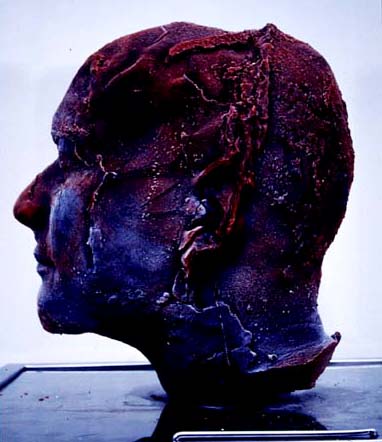
  • The red red bust of the artist, Mark Quinn (“Self”) cast and frozen in several pints of the artist’s own blood, maintained by a refrigerating unit, reminding us “of the fragility of existence”.
  • That Mary, Queen of Scots was the first woman to play golf and the word “caddy” evolved from the French military “cadets” who carried her clubs in France.
  • The smooth, lovely, long legs... of the King of England!
  • The gently entwined hands of the eloped poet-couple, Robert Browning and Elizabeth Barrett Browning, captured in bronze for eternity by Harriet Hosmer
  • The impeccably stylish Lady Colin Campbell, painted in black(dress) & ivory(skin) by Boldini; a stunning woman of “lightning wit” who married His Lordship, not knowing he was suffering from syphilis. It must be noted that she sometimes "wore a live snake around her throat in hot weather because it keeps one's neck so cool".
  • The Raging Red Eyes from the “Head of A Man” by L.S.Lowry who poured out his impotent rage as he watched his mother’s life ebb away... few know that he moon-lighted as a rent-collector. The many lives of angry artists.
  • The plaster bust of Dorothy Russell sculpted by the psychoanalyst, psychiatrist and artist, Ismond Rosen... a deserving honor, no doubt for the first woman to hold the 'Chair of Morbid Anatomy' at the London Hospital Medical College, apparently an eminent position, which a few of us might find semantically interesting.
  • The ascetic profile of DH Lawrence, infused with all the suffering brought about by the obscenity trial of 'Lady Chatterly’s Lover'. If you peek around with sufficient enthu, you might even spot the ironic Philip Larkin and his ‘Annus Mirabilis’, celebrating the discovery of sexual intercourse in 1963 when the book was finally allowed to be published (the first edition of which was dedicated to the jurors who returned the verdict of ‘Not Guilty’ in the obscenity case)
  • Paul McCartney, blissfully bleeding colour all over as “Mike's Brother” by Sam Walsh
  • Dame Judi Dench, looking like The Angel of Soothing Death, her mop of hair well-coordinated with her dress and matching the immaculate white of the canvas.
  • And if you’re persistent enough and try to escape to the basement as the closing bell rings, you will discover “The Singh Twins” series, a delightful modern interpretation of miniature Indian Art by Amrit & Rabindra, twin BBCD sisters. This colourful collection is complete with texting phones and DDLJ in the background... and even Muhammed Ali, reminding us (and all Americans) about his personal stand against the Vietnam War - “after all, no Vietnamese ever called me a nigger”. Truly, The Greatest Hath Spoken.
  • Until I saw their 1984, I did not know that at least 484 civilians were slaughtered in Operation Blue Star; always remembered it from high school history as a terrorist vs. army story. Another case of History being kind to those who write it, no doubt.

And in the final minutes as one slips down to the toilet, Venetia Dearden interrupts us with her work on the Glastonbury Festival... the strikingly innocent face of a young girl splendidly contrasting her pierced nipples and navel, around which her equally metaled boyfriend’s arms wrap around.

A cold, rainy afternoon, well spent, topped off with Kir Royale and some sautéed garlic mushrooms. Ooh-la-lah.

Tuesday, May 11, 2010

A Day In The Life Of India

The official global narrative of events in India is sometimes so misleading, that when the truth emerges, foreigners are stumped at the impossible contradiction of how we are the way we are. Here are two examples:

Case No 1: TELECOM-GATE

Official story: Government privatizes telecom, market booms, consumers get cheap handsets and cheaper tariffs, behold the world's fastest growing telecom market.
Unofficial story: In the background, someone in the Telecom Ministry auctions spectrum without proper guidelines or government consensus for what must have been “super-sized-incentives”. Real estate firms, stock broking firms, Tom, Dick, Chotu and Hari all apply for spectrum (after all, there’s no ‘tender’, it’s on a first-come, first served basis) and a small number of firms without any telecom expertise get valuable spectrum at grossly under-priced 2001 rates. The buyers (make that brokers) quickly mark up and resell licenses to foreign operators for huge profits soon after. Issue becomes public thanks to media (Ave 'The Pioneer'!) doing its glorious duty of exposing all, opposition parties demand resignation. The leader of the coalition party (to which the minister belongs, goes to Delhi, trots out the much-flogged, completely irrelevant caste horse. Matter not being actively pursued by Government because of the delicate nature of the coalition government. Oooooh.
Cry, My Beloved Country.

Case No: 2: IPL GATE
Official story: America-returned entrepreneur back in India, replicates NBA-style model for cricket, rejuvenates the sport, film stars cheer their own teams, nation rejoices & gets glued to new format.
Unofficial story: A junior minister jumps in to "mentor" a league bid, impropriety suggested, he resigns, other murky deals by murkier politicians come to light, the aviation minister’s daughter cancels a scheduled flight of the state owned airline and uses the plane to charter self and cricketers from her team. Caught in scandal, aforementioned entrepreneur claims innocence, denies owning proxy stakes in different teams, releases occasional emotional tweet, expresses sense of wonder and amazement about personal astrological predictions (including but not constrained to: ...is a dynamo...a package of raw radioactive energy... a true Pluto child... will soar like a phoenix... will conquer the 25 moons of Jupiter, surf the rings of Saturn and tenderly twist the time-space continuum... ok, I made up the last one), on verge of getting sacked, prepares to defend himself, as documents from his golden days as a part-time kidnapper emerge, detailing his arrest and indictment.

Comments from spectators: Dhiraj Nayyar of The Financial Express explains: "In many ways the I.P.L. is a confirmation of what India really is: an emerging economy". Ramachandra Guha reminds: "It is the India that is doing well economically. It shuts itself off from the other 800 million Indians who live in the hinterlands."
Another Day in the life of India.

Documenting Life - At The Barbican

The recently concluded London International Documentary Festival at The Barbican had some fantastic films in town and I got a chance to watch two of them:


Isolation is the story of Britain’s dispossessed war veterans; over 25% of former soldiers are living on the streets. Told by Stuart Griffith, a former veteran who too was once homeless, the story retraces his steps across the streets of England as he encounters former soldiers on the streets, on park benches, in temporary hostels – strong men, angry men, lost men with tattooed bodies and scarred minds.

It was eerie to watch this shadow-filled movie especially with the unforgiving and jarring live music; we see veterans whose flesh has been gouged out by shells and peeled by fire, who have lost limbs, lost half their mind watching friends die, who struggle everyday to make it to the blessed night. The stark loneliness of civilian life seems to be often the biggest shock for these men so used to the espirit-de-corps of military; Griffith walks us through the despicable unfairness of a system that grinds young men through war in strange lands and almost abandons them when they reach home.

In the post-screening discussion, the directors talked about how their movie was almost a portrait of the netherworld, of people inhabiting two different worlds. They explained how, after a while, a normal person might become immune to war statistics & body counts in the media; their making of this movie was intended to break through that veneer. As one of the directors said “How does society deal with the monsters it creates to fight wars? It would prefer that they be brushed under the carpet but I am going to annoy them”.

The movie ends on a grim note… More veterans of the Falklands war committed suicide than died in combat.

This Way Of Life on the other hand is the joyful celebration of a wild and fragile existence. It follows the life and family of Peter Karena as he copes with the burden of his ‘integrity’, his insistence on making a living off the land in the wilderness of New Zealand. Through the chaos of a burnt home, stolen horses and a raging father, Peter manages to hold on to his beliefs and manages to pull his family and his 50 horses through, barely at times, with him.

A strong man battling nature and malevolent family is cause enough for some spellbinding cinema but watching his brood, all 6 of them, grow up unabashedly, unafraid, untamed becomes a fiery raucous paean to mankind itself. As a 5 year old girl rides horses bareback and a 12 year boy guides fully loaded animals down a steep mountain slope, we gasp and sigh… in relief and in wonder of the impossibility of a man without a job, living in the forest with a woman he loves and teaching 6 lovely children how to lasso horses, swim naked and skin hogs. Amen.

Image sourced from the LIDF website here.

Monday, May 10, 2010

The Anatomy of Repression

Amnesty International India is running a Facebook campaign on the Top 10 Things to Know about the post-conflict situation in Sri Lanka; if you care about the issue, you might consider joining their soon-to-be launched signature campaign that puts pressure on the UN for an independent investigation.


During the Sri Lankan conflict, I had put up a note on The Anatomy of Repression (see below), about the Lankan government’s callous approach to what had become a humanitarian disaster. Especially notable is the first link, a posthumous letter from Lasantha Wikramatunge (former editor of The Sunday Leader, assassinated in January 2009) to the Sri Lankan President, sent from the grave – it sets the tone for everything that follows.


The Anatomy of Repression

Kill off dissenters...
http://www.newyorker.com/online/blogs/stevecoll/2009/01/letter-from-the.html

…block relief agencies…
http://www.guardian.co.uk/world/2009/may/20/red-cross-unrestricted-access-sri-lanka

… use children for propaganda…
http://innercitypress.blogspot.com/2009/05/in-manik-farm-camp-children-forced-to.html

… deny media reports on civilian casualties …
http://www.timesonline.co.uk/tol/news/world/asia/article6383477.ece

… and 'try' (spelled j-a-i-l) the messengers!
http://news.bbc.co.uk/2/hi/south_asia/8083505.stm

To be read, of course, in conjunction with The Dictator’s Handbook at:
http://www.foreignpolicy.com/story/cms.php?story_id=4877

(Oops, the last link's been swallowed by a subscription wall; it essentially talked about how dictatorships quickly adapt to circumstances, have learnt to use new technology like social media, uncannily co-opt allies and neutralize enemies by using a combination of quasi-legal (e.g. rigged elections) and guerrilla-like tactics (E.g. Sri Lanka playing off India vs. China in exchange for arms)... which were likely to have been the staple of the dissidents of the regime in the first place. A reader's reaction to this article is openly available here)

Tuesday, May 04, 2010

'Sand is like sand, but you are of the blue'


"Sand is like sand, but you are of the blue"

Nasiri Hajjaj’s movie “As The Poet Said” about the Palestinian poet Mahmoud Darwish starts with this line and wanders across half the world before coming home. On the last day of The London Palestine Film Festival at The Barbican Centre, we were granted a languorous film filled with the powerful poetry of Darwish read by people he knew, filmed in places that he had visited.... Tunis, Paris, Ramallah, Spain, Haifa – all illuminated brilliantly with only the starkness of his words.

The Director In the discussion after the movie, Hajjaj called this film his letter of love to Darwish; he spoke about how he had met the poet when he was young and wanted to make a movie about one of his Darwish’s epic poems (much to the consternation of the poet, apparently!) but never had the money to get it started.

The Title The title of the movie “As The Poet Said”, is supposed to be a phrase that’s culturally loaded with meaning in Arabic. Explaining the origin of this phrase, the director spoke about how Darwish would often use this particular phrase with reference to the 9th century poet Al-Muttanabbi, someone he considered THE most famous poet of all time in the Arab world. Hajjaj explained that “Al-Muttanabbi : Darwish, Darwish : Hajjaj” and voila, the title.

The Poet of The World The director also spoke about how he went out of his way to cast Darwish as a poet of the world rather than a poet of Palestine. He deliberately ignored the poet’s early nationalistic works and did not use the usual Palestinian collaborators of Darwish in the movie at all (“there are still people in Ramallah who are very angry with me”, he says, “Darwish was Palestine’s gift to the world and I want him to be remembered like that”). He also spoke about how he forced himself to use emptiness throughout the movie, saying that only the poetry should speak about Darwish and nothing else should detract from the experience.

The Readers Wole Soyinka and Jose Saramago, who read in the movie, had actually visited Darwish in Ramallah during the 2nd Intifada; Dominique De Villepin, the former French Prime Minister and poet, who also reads in the movie, had attended the poet’s funeral and wrote a moving elegy in the French press for him. Other readers include American, Israeli and several Middle –Eastern poets as also a dumb boy who shares in sign language, a Darwish poem that he knew.

The Democratic Flourish In explaining how the poems were selected (especially the ones read out by other poets), the director spoke about his democratic approach – he asked the reading poet to choose a Darwish poem and Najjaj himself would choose another one. The poet would read both poems for the filming but in his film, Najjaj finally used only the poems he chose. “Perfectly democratic”, he informed us.

The Poetry As an old, steady voice read the poem below, the frame panned across the landscape with old men, women, poets, Palestinian school-kids... reciting, reading, remembering these lines... I thought to myself, how better can a man be remembered, than for the force of his words and the fires that they light.

WE HAVE ON THIS EARTH WHAT MAKES LIFE WORTH LIVING
Mahmoud Darwish, 1986

We have on this earth what makes life worth living: April’s
hesitation, the aroma of bread
at dawn, a woman’s point of view about men, the works of
Aeschylus, the beginning
of love, grass on a stone, mothers living on a flute’s sigh and
the invaders’ fear of memories.

We have on this earth what makes life worth living: the
final days of September, a woman
keeping her apricots ripe after forty, the hour of sunlight in
prison, a cloud reflecting a swarm
of creatures, the peoples’ applause for those who face death
with a smile, a tyrant’s fear of songs.

We have on this earth what makes life worth living: on this
earth, the Lady of Earth,
mother of all beginnings and ends. She was called
Palestine. Her name later became
Palestine. My Lady, because you are my Lady, I deserve life.

(Image used was sourced from here)

Monday, May 03, 2010

The Mad Women of Gabriela Mistral


Just found my unread copy of Poetry News, Winter 2009 and in it, a lovely Latin American poem. Randall Couch's translation of "Locas Mujeres" by Gabriela Mistral won the 2009 Corneliu M Popescu Prize for Poetry Translation - here's a brief excerpt that I copied from Poetry News:

GABRIELA MISTRAL
from THE ABANDONED WOMAN

for Emma Godoy

(...)

I have sat down in the middle of the Earth,
my love, in the middle of my life,
to open my veins and my chest,
to peel my skin like a pomegranate,
and to break the red mahogany
of these bones that loved you.

I'm burning all that we had:
the wide walls, the high beams,
ripping out one by one
the twelve doors you opened
and closing with axe blows
the cistern of happiness.

Gabriela Mistral was the pseudonym of Lucila Godoy, the first Latin American to win the Nobel; she knew Neruda (another pseudonym, originally he was Neftali Basoalto) when he was a 16 year old aspiring poet, 3 years before the maddening brilliance of Twenty Poems of Love and A Song of Despair.

I never knew about Mistral until I saw this feature but it looks like she's written some exceptional literature. She says about her poetry:

"I write poetry because I can't disobey the impulse; it would be like blocikng a spring that surges up in my throat... it no longer matters to me who receives what I submit. What I carry out is, in that respect, greater and deeper than I, I am merely the channel"
.

Wow.

Image sourced from here.

Monday, April 26, 2010

Un Privilegio Raro

60's Italian version of #209 (Geordie) of Francis Child's collection of English and Scottish ballads.

Wednesday, April 21, 2010

Banishing Indian inequality through press conferences

Manmohan Singh on the Maoist threat recognizes that "“Rapid growth will have little meaning, however, unless social and economic inequalities, which still afflict our society, are not eliminated quickly and effectively.” He also urges civil servants to ensure that no area of the country is denied the benefits of the government’s developmental programmes.

Dear Mr.Singh,
Do you believe that
  1. Our existing civil governance infrastructure with a notably specious record
  2. With skewed incentives, rehashed development plans and large implementation gaps
  3. Dealing with the same resource hungry corporate players
will suddenly heed your call and start super-effective/efficient execution of your government's plans just because more people might be watching them?

Do you believe that and do you expect us to seriously believe that? Are these the most concrete plans that the PM and Home Minister (ministers I consider to be of the highest calibre in the current government) have for eliminating social and regional economic inequalities? (after an incident that shows the appalling fallout of not doing so).

Saturday, April 17, 2010

Opinions we can do without - C.V. Arvind in The Hindu

C.V. Arvind painstakingly writes in The Hindu about the perils of pre-marital sex and live-in relationships, an issue of undying importance to upholders of the definitive, untraceable collection of sacrosanct (Indian!) values (a shield usually deployed by morally-challenged, politically shrewd characters which includes the Shiv Sena, the RSS, Sri Ram Sena, random Mullahs issuing fatwahs against Sania's skirts etc).

I wonder how The Hindu let this completely WTF article slip through their usually reasonable quality gates. Note the flimsy assertions and generalizations unbacked by any data/research/findings/polls whatsoever other than the writer's (warped and repressed, I would say) opinions:
  • "Indian society, by and large, continues to frown upon both pre-marital sex and live-in relationships"
  • "In the West...couples walk in and out of relationships with consummate ease and with hardly any passion or affection characterizing these relationships"
  • "Entering into a bond where there are no vows or values is something that cannot be endorsed"
  • "One could well ask what sanctity is there in such live-ins"
  • "Often, when these live-ins come apart, they could scar either the man or woman for life"
  • "Pre-marital sex too is alien to our culture"
  • "Awareness has to be created in these young minds"
  • "It is in the interest of all that we continue to be old-fashioned and prude"
It must be admitted that one has to try very hard to retain any respect whatsoever for the intellect and education of such a writer and readers can choose to puzzle even harder as to how a respected national newspaper could allow such poor style and content. It is in the national interest for all concerned to do so... OMG, this is infectious. Stay away from this guy.

Friday, April 16, 2010

How do we wage a war against our own people?


In “Traffic”, Michael Douglas is a DEA official about to launch a “war against drugs”. At the last moment, he walks out of a press conference angrily recognizing the illogic of waging a war against one’s own own daughters and sons, victims and perpetrators in the uncharted waters of drug addiction.


The same question strikes me when I read the many arguments and counter-arguments about the Maoist struggle in the mineral laden states of India; the most recent of these were Arundhati Roy’s outstanding essay in Outlook and the CPI(Maoist) spokesperson interview’s in The Hindu. Anyone reading these (sometimes overly) impassioned pieces cannot but be moved by the poignant (and soon-to-be tragic?) struggle of illiterate men and women with muzzle loading rifles and pitchforks who take on the sophisticated legal might of Vedanta-like corporations, the financial and logistical muscle of the Indian government and the savagery of the Salwa Judum. Especially notable is Roy’s brief, acerbic dissection of the twisted language of war (“the Maoist infestation”, “The greatest threat to Indian democracy” etc). But all the literary eloquence of the world cannot mask the stench and horror of 75 dead CRPF men killed last week. So what is it that pits the Indian government to move battalions of police against terrorists… and also its own people? Minerals, apparently. Millions of tonnes of minerals.


A few good answers A couple of months back, I met an LSE grad who had done her PhD on the Maoist movement in India – she had visited Bihar, Jharkand, Uttaranchal etc and clocked miles and hours with both comrades and government officials. She summed up her findings thus - Wherever there are scarce natural resources, there are also fierce power struggles to control them. And inevitably, the local populace suffers and often suffers terribly. This is not a new chapter in human history: Red Indians were driven off their lands and away from their hunting grounds by American settlers looking for ranching land, gold and bison. The island of Nauru was thoroughly strip-mined of all its minerals by the British Phosphate Commission and left to die (or rather, to exist on pittances from becoming a tax haven and running detention centres for illegal Australian immigrants). “Avatar” rehashed this storyline, with humans attempting to wrest control of Unobtainium ore from the Pandorans. In an eerily similar real-life tale, a friend at Amnesty International shared with me their campaign against Vedanta’s attempt to mine the Niyamgiri Hills, sacred to the Dongria Kondh community.


I do not possess the legal, political or philosophical bandwidth to discuss issues of whom the land belongs to and which is the greater good; but whomsoever it belongs to and whatever its worth, surely there must be a more humane process to work this issue through… a process that does not completely condemn barely literate tribals to the mercies of unscrupulous corporations (make no mistake, I am a U.Chicago grad, all in favor of capitalism and free markets, but I was also alive when Bhopal happened to my countrymen), money-making chief ministers and masochistic vigilante organizations.


In this context, I disagree with Shankar Aiyyar of India Today who declares Maoists as terrorists (Yes!) and calls for a new strike force (considering sketchy human rights record of such forces, strike against whom exactly?) brushing aside what he calls “pacifist”(as opposed to a government’s war against its citizens?) objections. His strongest premise is particularly weak in an Indian context: that “a democracy affords many avenues to seek justice and violence is not an option”. I would invite Mr.Aiyyar to the Indian hinterland and ask him to go through the simple motions of registering any kind of complaint in a police station - what a joke! The only avenues of justice available in the Indian democracy are limited to those with one or more of the following:
A. An education
B. An income or wealth that can support bribery and legal costs
C. Extensive contacts in the political or bureaucratic system.
D. The means to inflict violence.
Let us try to guess which of these opulent options an Adivasi in the jungles of Jharkand could (not would) choose. Duh.


I suppose one should be relieved that the Honorable Home Minister of India and the Air Chief Marshall are unsure about the option of using air power for fear of collateral damage; apparently, it’s not just our government servants who are weighing such mighty choices – Harper’s Magazine (currently absconding behind a pay-wall) in a recent article by Ando Arike chronicles the many slippery-slope measures that authorities are considering against protesting and pestering populations. Options include microwaving people, low intensity lasers to make crowds singe and piss, flash-bang grenades that puncture ear-drums, all adding to a range of strategies & tactics to ensure success in “asymmetric confrontation” against restless civilian elements. Us unruly masses need to be taught unforgettable, humiliating, painful lessons on the consequences of naughty behavior, apparently.


Rants aside, why Pandora cannot exist It is stupid to argue that the earth be left in its pristine glory with minerals safely ensconced in their ore… it is only a matter of time before someone discovers/creates shortcuts to make a grab at such resources. Human need has driven human action and will do so forever, wherever, flattening the mountains of America and damning the rivers of China.


Neither does it make sense to always rant against MNCs the way Roy goes on about the Tatas, Vedanta and every other large company. The world does not possess enough resources that match the gentle alternative model that Roy suggests nor do its inhabitants possess the time and patience to wait for such a model’s results. Every day, the iPhones and Priuses of the world demand Bolivian lithium, lithe Formula 1 machines need Nigerian petroleum and millions of Indians want their feisty steel-clad Nanos - now! Such a world we have chosen and wrought, go figure. Rather than confining our reflections to the beauty of a night in the Jharkand jungle, we need to ask more pertinent, more realistic and more urgent questions, like:


PREMISE: Given that large corporations, mining industries, well-paid lobbyists and giant Chinese, American, Russian and Brazilian metal extractors and the irrepressible appetites of global consumers are here to stay…

QUESTION 1: How can we ensure that the transfer of scarce resources from traditional regional inhabitants (guardians?/ owners?/ people?) to industrial economies happens in the most civilized manner possible with the least costs inflicted upon human inhabitants?

QUESTION 2: How can the resultant benefits be spread across fairly across the chain - from the dwellers of the land to the sellers of the metals?

I know, I know, infinitely easier said than carried out. One would think that the world's largest democratic system would at least make an attempt to answer this with some modicum of decency … but no, the Indian government seems to have utterly failed. By abandoning legal and moral responsibilities to the whims of rapacious industrial partners and local politicians out for a quick buck, state and central governments have created a power vacuum, one that dacoits/ extortionist mafias/ Maoists moved to fill in quickly.

In the mines and quarries of Bellary, Naxalbari and Keonjhar, we sowed the wind… And an angry whirlwind visits us in Dantewada, reminding us of the questions we forgot to answer and the bodies that we need to bury. Thanks to the Roys, the Muhajirs, the Sainaths and the Hindus of the world who force us to confront the truth, almost swept under the carpet of economic growth.


Convoluted PS: The act of labeling something as “terrorism” and undertaking all further action based on that premise should not hold one back from recognizing, understanding and ultimately preventing the conditions that led to its formation in the first place. (Prevention not necessarily limited to scorched earth tactics that create desolation and call it peace). No?

PPS: Noompa does a neat job of explaining exactly where Arundhati Roy went too far and why it is a great “disservice to the compelling power of her underlying arguments”. Also note her links which lead on to some measured and rational responses.